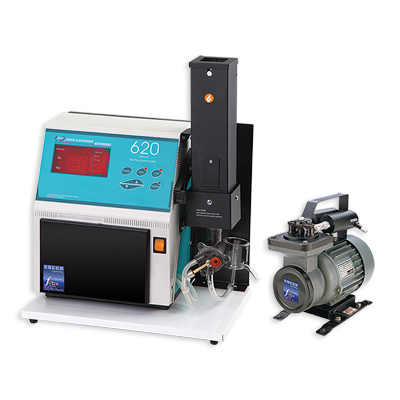

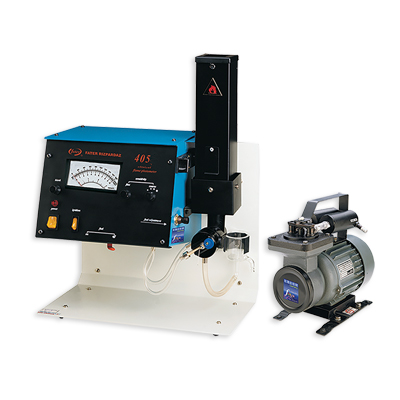
In the 1980s Bowling Barnes, David Richardson, John Berry and Robert Hood developed a device called the flame photometer to measure the concentration of sodium and potassium in a solution. The working principle of this device is the measurement of light energy and the shell spectrum of atoms.
To understand this topic and the process of measuring sodium and potassium with a flame photometer better, stay with us to the end of this article.
1The process of measuring sodium and potassium with a flame photometer
As we said, the working principle of the flame photometer is the measurement of light energy and the shell spectrum of atoms. The electrons in the atoms of metals, especially elements such as sodium and potassium, are excited by thermal energy and jump to a higher level.
At the new level, because of their greater energy and lower stability, the electrons return to the original orbit after a very short time. In this return, energy is emitted as light energy.
This light contains a specific wavelength that is different in each metal; for example, in sodium the wavelength of the light is yellow and equal to 590 nanometers, and in potassium the wavelength of the light is violet-tinged pink and equal to 765 nanometers.
The working process of the flame photometer is very similar to the fluorescence method, with the difference that fluorescence uses UV ultraviolet light energy, but the flame photometer uses thermal energy.
Before reading on, if you are not familiar with the flame photometer and how it works, see the article What is a flame photometer?
2Methods of measuring sodium and potassium in a flame photometer
Measuring the amount of sodium and potassium in a sample with the flame photometer is possible in the following two ways:
Direct method
In this method the light emitted by the elements, produced with the help of the flame photometer, is measured by a galvanometer. Then, with a standard curve at hand, the amount of the element is determined.
Comparison method
In this method the sample under test is compared with the light of a substance used as an internal standard. Then a specific amount of an element that is not present in the sample being measured is added to the solution. In measuring the amount of sodium and potassium, the element added is lithium.
The light from lithium can easily be separated from the sodium and potassium waves. Finally the sample's light is compared with the standard light and the final amount is reported.
3Fixing flame photometer problems when measuring sodium and potassium
When measuring sodium and potassium, problems may occur in the flame photometer that make the final answer faulty. Some of these problems and how to remove them are covered below:
The temperature of the device is not set
Sometimes the problem of the device may be that its temperature is not set; to remove this problem, an air pressure regulator, a pressure gauge and a gas regulator are used.
The amount of the sample under test is not constant
When the dilution of the solution is low, the device cannot measure the correct amount of the elements; to remove this problem the sample is diluted so that it easily turns into fine particles and the elements from it are released.
Non-uniform viscosity of the solution
To remove this problem, a specific amount of wetting agent is added to the solution so that the viscosity of the solution becomes uniform.
The effect of other atoms present
The problem that arises here is that some atoms absorb the light energy of other atoms, and some intensify the light energy of others. This problem can be solved with the following two methods:
- As far as possible the samples can be diluted so that the unwanted atoms are diluted too.
- A specific amount of the unwanted atom is added to the solution; for example, sodium intensifies the light of potassium. To control this effect, some sodium is added to all solutions, and since the sample is measured against the standard, the effect of the sodium will be neutralized.
Excessive dilution
Excessive dilution of the sample causes the atoms of the substance under test to ionize. To remove this problem, the suitable dilution must first be calculated and then the solution diluted.
High concentration
High concentration, besides causing unwanted effects of the unwanted atoms, causes some of the substance's light energy to be absorbed by its own atoms. To remove this problem, the calculation of the standards curve is used.
Closing words
The flame photometer is a device for measuring the elements present in a solution, such as sodium and potassium. In this article the process of this measurement was described completely. The types of measuring methods and the problems that may happen while working with the device were also explained, along with the technique for removing them. A point worth mentioning here is that today measuring the concentration of sodium and potassium ions in the human body is very important for carrying out various metabolic functions.